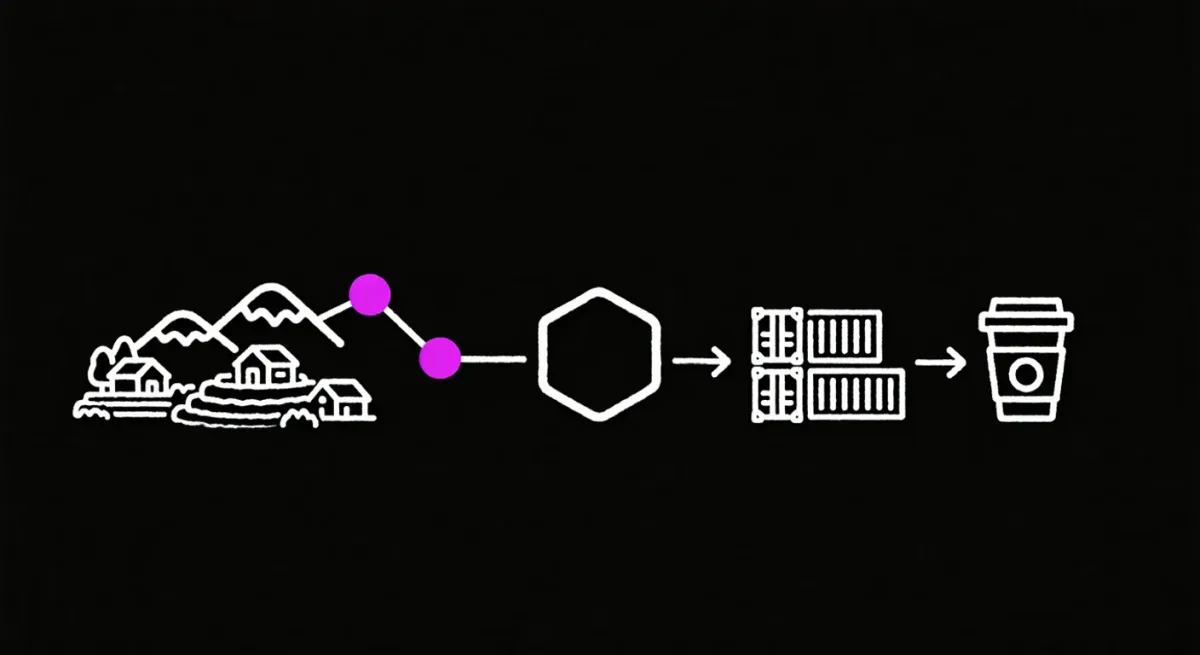
A typical Colombian coffee farm is smaller than two football pitches: a family plot of a couple of hectares on a Andean slope, picked by hand because the terrain allows nothing else, by one of the roughly 540,000 coffee-growing families the National Federation of Coffee Growers counts as its constituency (Federación Nacional de Cafeteros). That structure — millions of trees, thousands of meters in altitude, one federation — is the most distinctive production system in the global coffee industry, and it explains both Colombia's premium and its fragilities.
The federation model
Colombia organized its coffee economy in 1927, when growers created the FNC, a non-profit cooperative with a purchase guarantee at its core: any member, anywhere, can sell parchment coffee to the federation at a published price tied to the international market. A national coffee fund, fed by export contributions, finances the guarantee, research and the extension army of agronomists who advise farmers on renovation and disease. The arrangement — growers taxing themselves to stabilize their own incomes — has outlived every commodity cycle since, and its institutional cousin, the Juan Valdez brand launched in the early 1960s to capture retail value, put the fictional grower on New York billboards decades before 'origin' was a marketing category.
Why Colombian beans carry a premium
Three structural facts. Colombia grows virtually 100 percent arabica, washed-processed, in the mild 'Colombian Milds' category that roasters pay differentials for. Its equatorial latitude permits two harvests a year, spreading supply. And altitude — much of the crop grows between 1,200 and 2,000 meters in Huila, Nariño, Antioquia and Tolima — slows cherry maturation and builds the acidity the market prizes. Output runs in the low tens of millions of 60-kilogram bags annually, second in arabica only to Brazil, and the denomination of origin protects the name legally (FNC; ICO statistics).
The strain lines
- Price: the international C-market price, set in New York by futures trading in which Colombian farmers do not participate, moves farm-gate income violently; the federation's stabilization tools cushion but cannot repeal it.
- Climate: coffee leaf rust, which destroyed a third of the crop in the 2008-2011 crisis and forced a national replanting toward resistant varieties, thrives in warmer, erratic weather; flowering depends on dry-wet rhythms that El Niño and La Niña years scramble.
- Economics of scale: a two-hectare farm supports a family at Colombian rural standards but cannot mechanize, so labor costs — and labor shortages at harvest — bite harder each year.
- Competition: Brazil's mechanized volumes and Vietnam's robusta set the floor price the whole market trades around, while new origins chase the specialty niche Colombia assumed it owned.
The specialty answer
The industry's response has been to climb its own value chain. Micro-lots, variety separation (pink bourbon, gesha/geisha), fermentation experimentation and direct-trade relationships now pull auction-level prices for a thin top layer of farms, while cooperatives and the FNC push cupping, certification and traceability through the middle of the crop. Coffee tourism — farm stays in the Coffee Cultural Landscape, a UNESCO World Heritage region since 2011 — adds a services margin to the same trees. The strategy's honesty is that it cannot lift 540,000 families into auction prices; it can raise the average and finance the floor.
| Element | Detail |
|---|---|
| Growing families | ~540,000 (FNC constituency) |
| Farm size | Predominantly under 5 hectares |
| Varieties | 100% arabica, washed process |
| Core regions | Huila, Nariño, Antioquia, Tolima |
| Heritage status | Coffee Cultural Landscape, UNESCO 2011 |
What to watch
The C-price cycle, always; the pace of renovation into rust-resistant varieties after each weather shock; the share of export value captured by specialty and certified channels, which the FNC publishes; and the demographic one nobody's marketing solves — the average Colombian coffee farmer is aging, and the harvest labor force is thinning. The federation has survived a century precisely by treating such questions as engineering. The next decade tests whether smallholder engineering still works in a climate and price regime that no longer cooperates.
The price floor machinery
The federation's most consequential instrument is the one farmers never think about until it matters: the purchase guarantee. The FNC publishes a base price tied to the New York market, and its buying network stands ready at hundreds of collection points to purchase any member's parchment coffee at that price, on the spot, in cash. In a normal year most farmers sell to private exporters who compete above the floor; in a price trough, the floor becomes the market — the federation's warehouses fill, the coffee fund absorbs the difference, and smallholders survive a year that would otherwise liquidate them. Economists debate the distortions such floors create; Colombian farmers point to the crises the mechanism has bridged, and the industry's institutional stability across a century of commodity cycles is the empirical defense.
The second stabilizer is informational. The FNC's research arm — Cenicafé, one of the world's best-funded coffee research institutions — bred the rust-resistant varieties that rebuilt the industry after the 2008-2011 collapse, publishes the agronomic guidance most farmers follow, and runs the extension service that reaches plots no agronomist would otherwise visit. Taken together, the purchase floor, the research pipeline and the extension network are why Colombia's coffee sector, alone among its agricultural industries, behaves like a system rather than an aggregation of exposed small businesses. The federation's critics — and there are many, on both market and cooperative grounds — still organize their critiques around the machinery's terms.
For how another Andean country turned native ingredients into a global brand, read our feature on Lima's gastronomy economy, and explore more in the Andes section.