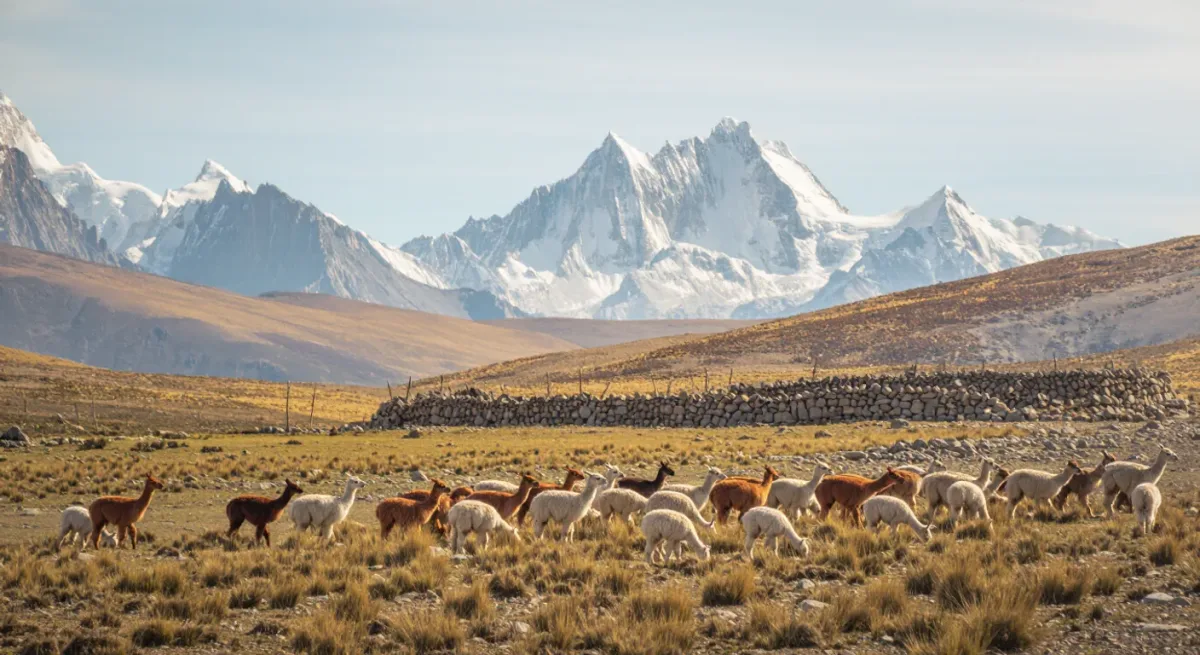
At 4,300 meters in Puno region, the shearing season is a family operation: animals restrained by hand, fleece cut in one piece, sorted on a blanket by a sorter whose fingers can grade fineness to the micron without a laboratory. Peru holds roughly four million alpacas — the overwhelming majority of the world herd, per Ministry of Agriculture and agrarian census data — and the highlands communities that keep them sit at the bottom of a global luxury fiber chain whose top end sells knits for the price of a month of herder income. The economics of that ladder, and every attempt to climb it, is one of the Andes' clearest development stories.
The animal advantage
Alpaca fiber occupies a rare commercial niche: softer and warmer than sheep's wool, produced at industrial scale in essentially one country. Two breeds matter — huacaya, the fluffy majority, and suri, the rarer lustrous fleece that drapes like silk — and within each, fineness grades from around 23 microns down toward the royal alpaca territory under 19 microns that commands multiples of base price. Fiber, meat and the animal's role in highland culture make the alpaca a multi-use asset for families whose diversified survival strategy has always included selling wool, but the export game rewards fineness, and fineness rewards feed, genetics and careful shearing — inputs that capital, not tradition, provides.
How the chain is structured
- Herders: hundreds of thousands of families across Puno, Cusco and the southern altiplano, selling raw or artisanally spun fiber locally.
- Collectors and associations: intermediaries and cooperative structures aggregating fleece to mill grade; the sorter's skill — separating micron classes by touch — is the chain's quiet quality gate.
- Mills: dominated by the Arequipa group that grew into the world's largest alpaca processor, capable of industrial dehairing and top-making that artisanal spinning cannot match.
- Luxury retail: European and increasingly Asian fashion houses, plus Peru's own brand-led challengers building design and export under the country's name.
The value-capture problem
The policy literature calls it the classic primary-commodity trap: the fiber leaves Peru in bulk top or yarn, and the garment margin is captured where design, branding and retail live. Peruvian export statistics show textile and apparel exports growing faster than raw fiber exports in recent years — evidence the ladder is being climbed at the industrial level (MINCETUR; ADEX data). At the herder level the climb is slower: price premiums for fineness have pushed genetic improvement programs, shearing training and cooperative sorting, and the state's Sierra Exportadora-type programs have spent years formalizing exactly these links. Climate is the wildcard — drought years on the altiplano degrade fleece and force animal sales, and the freeze events that kill herds erase genetic progress in a week.
| Chain stage | Where value is added |
|---|---|
| Herder | Fleece production, artisanal spin |
| Sorter/cooperative | Micron grading — the quality gate |
| Mill (Arequipa cluster) | Industrial dehairing, tops, yarns |
| Design and brand | Garment margin — the prize |
Certification and the authenticity market
As luxury consumers demand provenance, Peru has moved to certify origin along the chain — alpaca's single-country supply makes authenticity enforceable in a way cashmere's multi-country herds are not. The sustainability question extends to animal welfare and land management, standards that international buyers increasingly write into contracts. For herder communities this is double-edged: certification can raise prices and exclude the unprepared; the cooperatives that navigate it become, in effect, quality exporters rather than raw-material sellers.
Why it matters beyond knitwear
The alpaca chain is the Andes' most legible case study in whether a natural-resource monopoly can be converted into an industrial brand. The herders own the animal nobody else has; the mills own the processing; the brands own the customer. Each decade since the 1990s has moved one rung of that ladder toward Peru — first processing, then export yarns, now finished design. The fiber on the sorting blanket at 4,300 meters is the same fiber in a Milan boutique; the distance between its two prices is the entire development question.
The wild cousin in the royalty tier
Above the alpaca ladder sits a fiber the market prices like contraband silk: vicuña. The wild ancestor of the alpaca, protected under international conservation convention, can be shorn only through regulated community captures — the chaccu, the traditional roundup revived as a management ritual — and its fleece, finer than 13 microns, sells at multiples of the best alpaca. Peru manages the population through community concession areas, converting a once-endangered species into a guarded asset whose annual harvest funds the same highland communities that guard it. The model's lesson runs directly against commodity instinct: the scarcest, most expensive fiber in the Andes is the one nobody is allowed to farm, and its price is the purest expression of the region's brand — provenance, scarcity, tradition — rather than its volume.
Vicuña's commercial history also explains today's certification instincts. In the 1990s, when legal shearing programs began, the industry built traceability from first principles — every bale documented from capture to mill — and luxury houses learned to market Andean fiber with the vocabulary of conservation. The same machinery now underwrites alpaca's provenance claims and sustainability standards: the certification regimes buyers demand today are descendants of the systems invented to prove a wild animal's fleece was lawfully shorn. The highlands' fiber economy, in other words, runs an entire pricing structure on institutional trust — which is precisely the asset its competitors cannot replicate.
For the other high-altitude resource where Peru and its neighbors compete up the value chain, read our guide to Bolivia's Salar de Uyuni, and explore the Andes section.