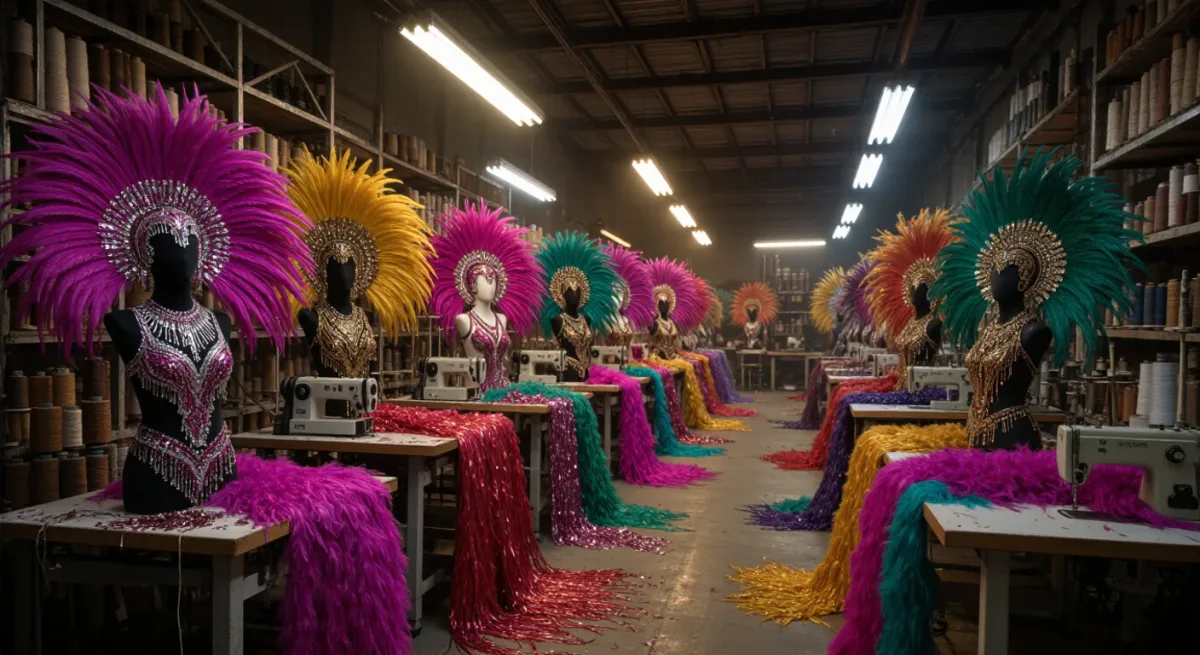
In the port-district warehouse complex where Rio's top samba schools build their parades, carnival season is not a week — it is a production calendar that starts the morning after the previous championship. Carpenters weld alegorias — the rolling floats — under scaffolding; seamstresses run feather and sequin work through the southern-hemisphere winter; the bateria rehearses on Sunday nights in the courtyards, open to the neighborhood. When the schools enter Marquês de Sapucaí avenue in February, each presents several thousand components — dancers, wings, floats, the drum battalion — the output of a year of paid and volunteer labor organized with industrial discipline (LIESB and Liga regulations; Rio city government culture data).
Anatomy of a school
A top-tier samba school is simultaneously a neighborhood institution, a competitive franchise and a production company. Its community base — the quadra, the weekly open rehearsal that doubles as the neighborhood's social life — supplies the parade's wings and its identity. Its professional core — carnavalescos (the creative directors who design the entire presentation), mestre-sala and porta-bandeira couples, the mestre of the bateria — are salaried specialists in a labor market the league's relegation system prices ruthlessly. And its board, in recent decades, has included the political operators and, latterly, the betting-company sponsors whose logos now fund the spectacle — the latest chapter in carnival's long history of financing itself through whoever has money (league and press records).
- Components: 3,000-5,000 members per school in the top division, capped and timed by regulation.
- Budgets: tens of millions of reais for a competitive campaign in the special group.
- Venue: the Sambódromo (1984, redesigned by Oscar Niemeyer), capacity around 72,000.
- Relegation: promotion and demotion between divisions, the competitive engine that prices talent.
What the week is worth
The municipal accounting runs to hundreds of millions of reais in direct economic activity: hotel occupancy near total, air capacity added, street parties (blocos) drawing millions cumulatively across the pre-carnival weekends, and broadcast rights that carry the Sapucaí to national and international audiences. The celebration's deeper economics are distributional: carnival is one of the few moments the city's money flows uphill — from tourists and sponsors into the port-district and north-zone neighborhoods that build the parade, employing tailors, welders, choreographers and musicians whose annual calendar carnival anchors. The schools themselves are the social infrastructure of communities the formal economy under-serves, a fact visible every non-carnival month in their community programs.
| Element | Scale |
|---|---|
| Schools in the special group | 12 |
| Components per school | 3,000–5,000 |
| Sambódromo capacity | ~72,000 |
| Production cycle | Full year |
The contemporary tensions
Three. Funding: sponsorship concentration — first state oil money, now sports-betting firms — has made school budgets hostage to corporate cycles and regulatory whims, and the league's television arrangements redistribute unevenly. Authenticity: the spectacle's globalization pulls creative briefs toward broadcast-friendly spectacle, a tug the purists document every season. And labor: the seamstress paid by the piece through the winter and the welder in the warehouse are carnival's real working class, and their conditions — like the porta-bandeira's knees — are the industry's unglamorous maintenance file. None of these tensions is new; all of them are the price of scaling a neighborhood ritual into a global broadcast.
Why it endures
Because the competition is real and the community is real. The relegation system guarantees that every February a hundred years of tradition is put on the line against a scoring rubric, and the quadra guarantees that whoever wins, the neighborhood keeps its school. Few cultural industries anywhere combine that stake structure — amateurs competing with professional discipline for a trophy with no cash value — and it is precisely that structure that has kept the parade reinventing itself for a century while the world watches.
The school as employer
The labor market inside a samba school is more intricate than the parade suggests. The year-round staff — the carnavalesco's creative team, the workshop masters, the drivers, the kitchen — are salaried; the parade's performers divide into those who pay for the privilege (the alas, the costumed wings whose members frequently fund their own fantasies — the school's true box office) and those who are paid (the destaques, the choreographed soloists; the vedettes; the contracted musicians who reinforce the bateria). The costume workshops run on piece rates — seamstresses paid per fantasy produced, work that peaks in the southern winter when the rest of Rio's economy is quiet, an inverted seasonality that makes carnival the anchor employer of entire craft neighborhoods.
The warehouse trades — carpenters, welders, sculptors, electricians who build and animate the alegorias — are skilled industrial labor organized around an annual deadline, and the Cidade do Samba complexes concentrate them into something like a seasonal industrial district. Employment law has followed the work: courts and the labor ministry have litigated the employment status of parade roles and workshop crews across decades, and the league now publishes norms on member registrations and responsibilities. The economics amount to a strange, functional hybrid — part cooperative, part theater production, part public works project — and every February it delivers, on schedule, the largest staged event on earth.
Count the whole production chain and carnival employs, directly or seasonally, tens of thousands across Rio alone — a cultural industry whose payroll peaks in the southern winter, when the city's other engines idle.
For how Brazilian music built its global business beyond the avenue, read our feature on Brazilian music's exports, and explore the Brazil section.