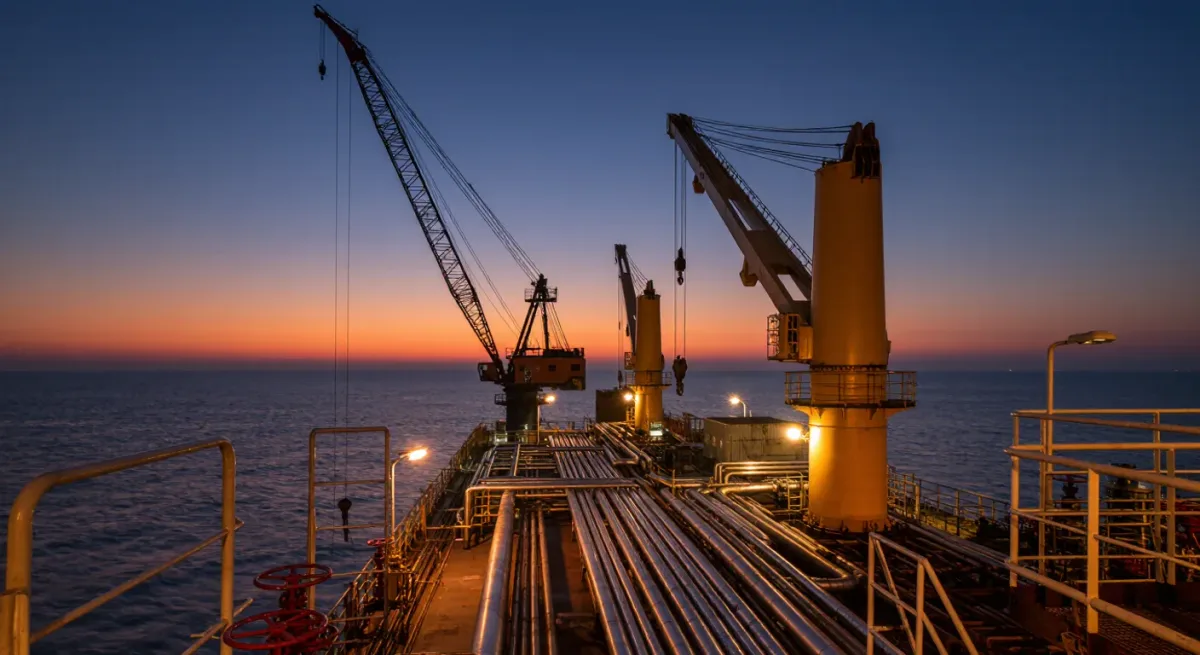
Pre-salt is the name for the oil reservoirs buried beneath a salt layer up to two kilometers thick under the Atlantic seabed off Brazil's southeast coast — discovered in the late 2000s, so productive that they now supply roughly three-quarters of Petrobras's output and generate the cash that made the state-controlled company one of the world's largest dividend payers. The Tupi field alone ranks among the biggest deep-water discoveries of the century, and the fields behind it — Búzios, Mero, Sepia — produce at volumes and per-barrel costs that few provinces on earth can match (ANP production data; Petrobras filings).
The geology, briefly
When the South Atlantic opened, separating South America from Africa, the young ocean's evaporating basins laid down salt over organic-rich rock; over 100-plus million years, heat and pressure turned the organics to oil and the salt into a seal. The result: reservoirs of exceptional quality under an impermeable blanket, drillable only through the salt — a technical challenge the industry solved with drill ships, long horizontal wells and subsea factories operating below two kilometers of water and several more of rock. Brazil's pre-salt breaks even at price levels that make most deep-water provinces uneconomic, which is the entire strategic fact.
Who owns it, who runs it
The legal regime is the direct product of the discovery's scale. The 2010 petroleum law split the pre-salt into concession-era blocks and production-sharing contracts in which the state, through Pré-Sal Petróleo (PPSA), takes the profit oil above cost recovery; the Union holds a controlling stake in the so-called transfer-of-rights volumes; and Petrobras holds operatorship and minimum participation rights in new pre-salt rounds. The result is a deliberate architecture: private capital and expertise welcome, control and upside reserved (ANP; PPSA contractual disclosures). International majors — Shell, TotalEnergies, Equinor, Chevron, CNPC, CNOOC — hold significant pre-salt partnerships, but Petrobras runs the flagship fields.
Why the dividends are enormous
Petrobras's cash generation is a spread business: world-class barrels at below-world-average lifting costs, refined in a system the company dominates, with a debt load cut sharply from the 2014-2016 price-crash era. Under a shareholder remuneration policy tied to debt ratios, the cash above investment thresholds returns to owners — and because Brazil's federal government is the controlling shareholder, an outsized share of the payout lands in the national treasury in election-relevant years. The political economy is therefore circular: the same state that owns the company depends on its dividends, which disciplines both dividend cuts and production adventures (Petrobras remuneration policy; treasury receipts record).
| Element | Detail |
|---|---|
| Share of Petrobras output | ~3/4 from pre-salt fields |
| Flagship fields | Tupi, Búzios, Mero, Sepia |
| Regime | Production sharing + transfer of rights; Petrobras operatorship |
| Investment plan | 2025-2029 capex around $111 billion |
The standing controversies
Three, permanent. Fuel prices: since the 2023 return to import-parity pricing, gasoline and diesel at the pump follow the exchange rate and global markets — a policy that ended the subsidy-versus-dividend improvisations of earlier years but leaves the government exposed to every oil-price spike. Energy transition: Petrobras's 2025-2029 plan leans further into oil and gas while rivals diversify, a bet management defends with pre-salt's low-carbon-per-barrel intensity and critics read as doubling down on a closing window. And capex discipline: the $111 billion plan is the largest since the 2013 era, and the industry's memory of what happened after 2014 — overinvestment meeting a price crash — is the institutional scar tissue every shareholder letter now references.
Why it matters beyond Brazil
Pre-salt added a strategic non-OPEC, non-Russian growth province to the world's supply map at exactly the moment globalization of energy fractured. Every incremental pre-salt barrel disciplines Atlantic-basin prices, displaces higher-cost supply, and gives Brazil the trade surplus cushion that funds everything else in its external accounts. For anyone modeling the oil market of the 2030s, the floatels over Búzios are as load-bearing a data point as anything decided in Vienna.
The fuel-price file, in one paragraph of history
No aspect of Petrobras is more politically charged than the pump. For most of the 2010s the company priced gasoline and diesel below import parity — a subsidy to consumers that accelerated when the government held prices down through the 2018 truckers' strike, a national shutdown that ended with concessions repricing billions — and the resulting domestic-price discount pushed refiners' margins negative and invited fuel imports. The 2023 return to a formal import-parity policy, maintained since, ended the improvisation: pump prices now track the exchange rate and global markets with published methodology. The policy is economically orthodox and politically permanent fodder — every oil-price spike or real depreciation now transmits to Brazilian pumps within weeks, and every election cycle rediscovers candidates promising to un-track them. Investors price that risk into the stock; drivers price it into approval ratings; the company holds the language of methodology while both sides argue.
The refining map changed alongside: divestments in the early 2020s transferred coastal refineries to new operators, breaking the company's near-monopoly in fuel supply — a liberalization that regulators and analysts frame as the pump-price era's structural complement. Petrobras remains dominant; it is simply no longer alone, and the competitive margin that introduces is the quietest policy legacy of the pre-salt decade.
The company's century has taught one governance lesson above all: at YPF, strategy is never only commercial — every balance-sheet decision is read, correctly, as politics by other means.
For what the wider Brazilian economy did with the pre-salt decade, read our report on Brazil's 2025 GDP, and explore the Brazil section.