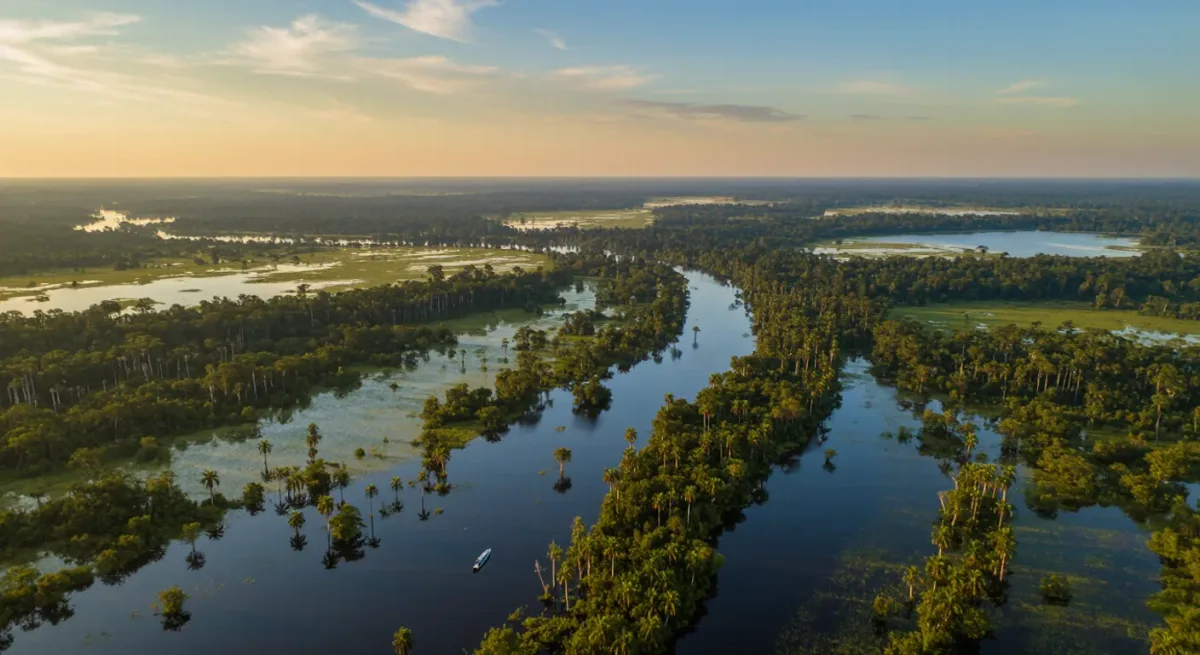
In the floodplains of the Amazon estuary, açaí palms grow in stands so dense the canopy reads as forest, because it is forest: managed, harvested by climbing families, and productive only while the ecosystem around it stays intact. The state of Pará produces the overwhelming majority of the world's açaí — a berry that went from river-village staple to global superfruit in two decades — and in doing so built the region's largest working demonstration of the bioeconomy thesis: standing forest can out-earn cleared forest (IBGE agricultural statistics; Pará state economic data).
How the açaí economy works
Açaí is river people's agriculture. The palm fruits during the second half of the year on the várzeas — the floodplains the Amazon pulses through annually — and families harvest by climbing, strip the fruit, and float it to processing points in small boats. Pará's interior consumes enormous quantities domestically — in river communities, açaí with farinha and dried fish is a meal, not a smoothie — while the export industry, centered on the Belém-adjacent municipalities, pasteurizes pulp for São Paulo, the United States and increasingly Europe and Asia. Export values have grown at double-digit rates for years from a small base, and the global functional-food category keeps repricing the berry upward (Secom-Pará trade data).
- Production base: smallholder floodplain management, not plantations — the system's ecological credibility and its supply constraint at once.
- Domestic market: by far the largest share of output, consumed within Pará and Brazil.
- Export market: pasteurized pulp and derivatives, premium-priced, growing fastest.
- Ecology: managed floodplain stands maintain forest cover, fish habitat and the river's nutrient cycle.
The bioeconomy argument
The region's economic default has been extraction: timber, then pasture, now in places illegal gold and land speculation, each converting forest to a lower-value, higher-entropy use. The bioeconomy thesis — advanced by the state government, researchers and a growing coalition of companies and Indigenous and riverine organizations — is that value chains built on standing biodiversity (açaí, cacao, Brazil nuts, pirarucu fish management, timber under community forestry certification) can pay competitive incomes per hectare without conversion. Belém hosted the global climate summit COP30 in 2025 precisely to make this argument from the Amazon's own ground, and the gathering accelerated bioeconomy financing commitments from development banks and food companies (COP30 record).
Where it strains
Scale is the first problem: global açaí demand is a rounding error next to soy or beef, so the bioeconomy cannot yet absorb the labor or land pressure pushing at the forest frontier. Quality and formality are the second: production is seasonal, perishable and largely informal, which limits the bankability of the producers the model is supposed to enrich — certification, cold chains and processing investment are the bottleneck, not agronomy. And the third is honesty in accounting: 'açaí saves forest' is true at the floodplain's scale and false as a slogan for the whole Amazon, where the frontier's economics are set by commodities the bioeconomy does not yet compete with. The deforestation data of recent years — sharply down from the 2000s peaks under enforcement — shows policy can bend the curve; whether income can hold it bent is the bioeconomy's test.
| Bioeconomy chain | Product | Model |
|---|---|---|
| Açaí | Pulp, exports | Floodplain agroforestry |
| Cacao | Fine-flavor cocoa | Cabruca-style agroforest |
| Brazil nut | Extractivism | Standing-forest harvest |
| Community fisheries | Pirarucu management | Quota-based lakes |
Why investors now visit Belém
The capital of Pará has become the bioeconomy's deal-flow city: a port complex expanding for forest-friendly exports, a cocoa and açaí processing cluster, university andEmbrapa research programs, and the post-COP30 attention of food multinationals hunting deforestation-free supply chains they can certify. The bet, put plainly, is that the next decade's premium food ingredients come with provenance requirements the Amazon is uniquely positioned to meet — and that the infrastructure built to move them is the same infrastructure that makes standing forest a business rather than a subsidy.
The stakes, plainly
The Amazon's fate is usually argued in carbon and biodiversity terms, which are real. The bioeconomy adds the missing term: the income of the people who live there. Açaí's two decades prove the mechanism works — forest-native product, global demand, river-community income — at one product's scale. The project now is to find ten more chains like it before the frontier closes the option.
The 24-hour clock
Açaí's industrial difficulty is that the fruit begins degrading almost the moment it leaves the palm: the clock on quality runs roughly a day from harvest to thermal processing, which is why the processing plants sit inside the producing municipalities — a river-belt industrial geography of pasteurizers and freezing lines adjacent to the floodplain groves — and why every efficiency gain in the chain is measured in hours. The perishability defines the market structure: smallholders deliver to family-run buying points that grade and rush fruit to pulp lines; the pulp freezes into the commodity that reaches Brazil's cities and the export terminals; and the premium tiers — organic certification, differentiated varieties, managed-forest provenance — pay for traceability systems that an unperishable crop would never require. Quality açaí, in other words, is a logistics achievement wearing a health-food label.
The same clock explains the sector's fragility and its innovation agenda. Cold-chain investments, faster boats, better baskets — each hour shaved from the chain widens the radius a processing plant can draw from and raises the fruit price a farmer can capture without any change in the grove. The public research system has treated this as the industry's core file: postharvest protocols, processing standards and varietal selection dominate the açaí research programs, and the export industry's growth curve has tracked infrastructure — roads, river terminals, cold storage — more than demand, which global marketing has never failed to supply.
For the cultural export the Amazon sends downriver to the world's dance floors, read our feature on Brazilian music's global decade, and explore the Brazil section.