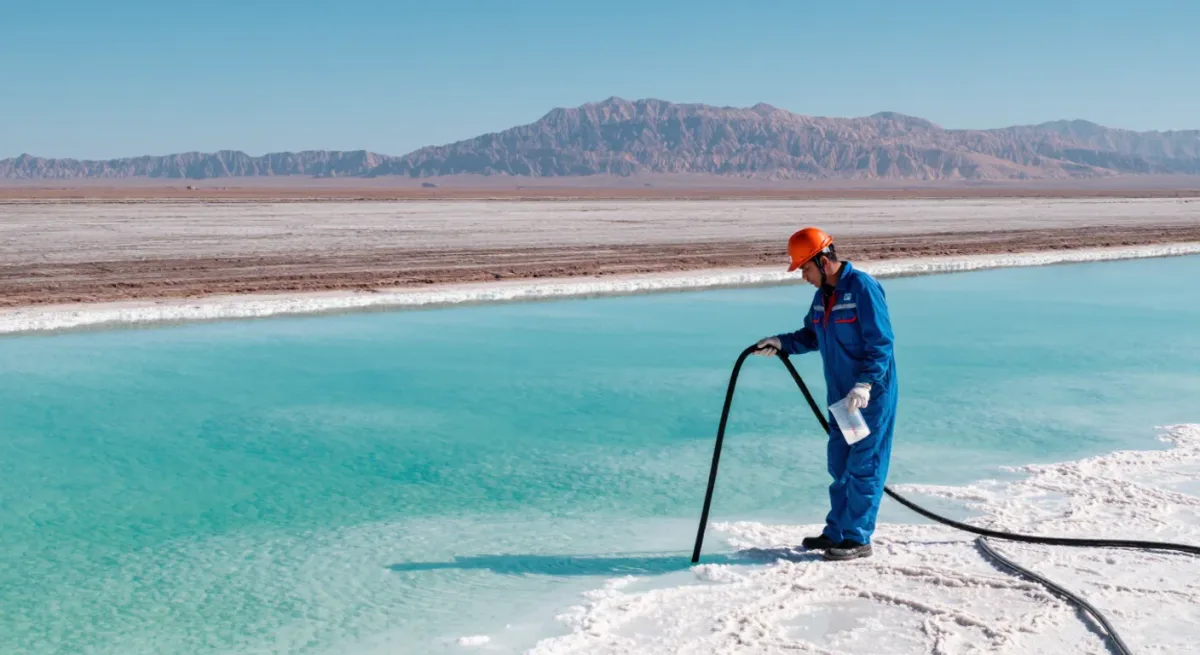
Chile's lithium strategy is the state-led half of the lithium triangle's natural experiment: a 2023 policy that keeps the metal legally a strategic resource, routes expansion through state copper giant Codelco and mandates public-private partnerships, all while the country remains the world's second-largest producer after Australia. The bet is that Chile can capture more value from its salt flats without frightening the capital that develops them — a balance it has been negotiating ever since (Government of Chile, National Lithium Strategy, 2023).
What the strategy actually changed
Three things, structurally. First, it declared lithium — until then governed under a mining-concession system with two dominant operators — a strategic resource for national development, tilting the legal frame toward the state. Second, it instructed Codelco, the state copper company, to lead development in new salt flats, most prominently by negotiating a joint venture with SQM, the private chemical firm that has operated the Atacama since the 1990s. Third, it created a National Lithium Company as a platform for future partnerships, and reserved a role for state development agency Corfo, which already collects rents from the Atacama leases it administers.
Why the Atacama is the whole game
The Salar de Atacama in Antofagasta region is not just any salt flat: its brines are the richest known, its evaporation conditions near-perfect, and it has supplied on the order of a quarter or more of world lithium output in recent years. SQM pumps the southern lease; the US major Albemarle the northern one, under contracts with Corfo that escalate royalties as production and prices rise — a design that made the Chilean treasury a direct beneficiary of the 2021-2022 price spike. The strategic question for Santiago is simple to state and hard to answer: how much more can the Atacama give before water balance and community consent say stop, and where does growth go afterward (Cochilco; Corfo lease terms).
| Pillar | Instrument | Status |
|---|---|---|
| Strategic-resource doctrine | 2023 policy decree | In force |
| Atacama consolidation | Codelco–SQM joint venture | Agreed, transition staged through the decade |
| New salt flats | Codelco-led partnerships (Maricunga etc.) | In negotiation |
| Public platform | National Lithium Company | Created |
Who wins and who waits
The model's winners are visible. Codelco, whose copper business faces ore-grade decline, gets a second act in a growth metal. SQM secures continuity in the Atacama beyond its original lease horizon in exchange for sharing control. The treasury gains a thicker claim on the value chain. The waiters are just as visible: junior explorers who staked ground under the old rules and now find their projects contingent on state partnership; neighboring Argentina, whose open provincial model looks more attractive by comparison and has harvested the exploration dollars Chile's policy chilled; and electric-vehicle buyers, in whose supply-chain math Chilean incremental tonnage matters more than Chilean rhetoric.
The extraction-technology wrinkle
Buried in the strategy is a quiet industrial bet: Chile wants direct lithium extraction — technologies that pull lithium from brine without vast evaporation ponds — to be the future of the Atacama's neighbors and eventually the Atacama itself, for environmental and water-balance reasons. The technology is real but commercially young, with plants operating or ramping in Argentina and pilots in Chile. If it scales, it changes the map; if it stalls, Chile's expansion plans meet the same water arithmetic the ponds face, with fewer alternatives.
What to watch
Four markers will tell whether the strategy is more than a legal rearrangement: the Codelco-SQM venture's actual production governance after its staged handover; the first new salt flat put into production under state leadership — Maricunga is the obvious candidate, hostage to water permits; the National Lithium Company's first deal that is not a Codelco rerun; and the price cycle's verdict, since a sustained trough tests state-led patience as ruthlessly as it tests private. Chilean lithium has one abiding advantage no policy can create or destroy — geology that produces at costs most of the world envies — and the strategy is, at bottom, an argument about who captures that margin.
Where the money goes
The Atacama's rents flow through Corfo, the state development agency that administers the leases and has turned the salt flat into one of Chile's most productive fiscal assets. The contracts with SQM and Albemarle escalate royalties with production and price, which meant the 2021-2022 boom delivered windfalls to regional development funds around Antofagasta — the practical answer to the perpetual question of what a region earns from the mineral under it. A defined share of lease income is allocated to the surrounding communities and municipalities, funding that local politics now treats as baseline rather than bonus, and the arrangement is studied wherever resource regions negotiate their cut.
How much more the Atacama can give is the file behind the file. The basin's water balance — how much brine extraction affects the lagoon ecosystems fringing the salar — is genuinely unsettled science, monitored by regulators with competing studies and litigated by communities and environmental groups. The operators argue the brine they pump is not the water the ecosystem uses; hydrologists respond that in a closed basin, everything is connected on some timescale. The regulatory resolution of that argument — monitoring standards, extraction caps, restoration obligations — will set the ceiling on Chilean output more decisively than any mining ministry communiqué.
For the other side of the salt-flat competition, read our explainer on Argentina's lithium triangle, and for more high-altitude economics, explore the Andes section.