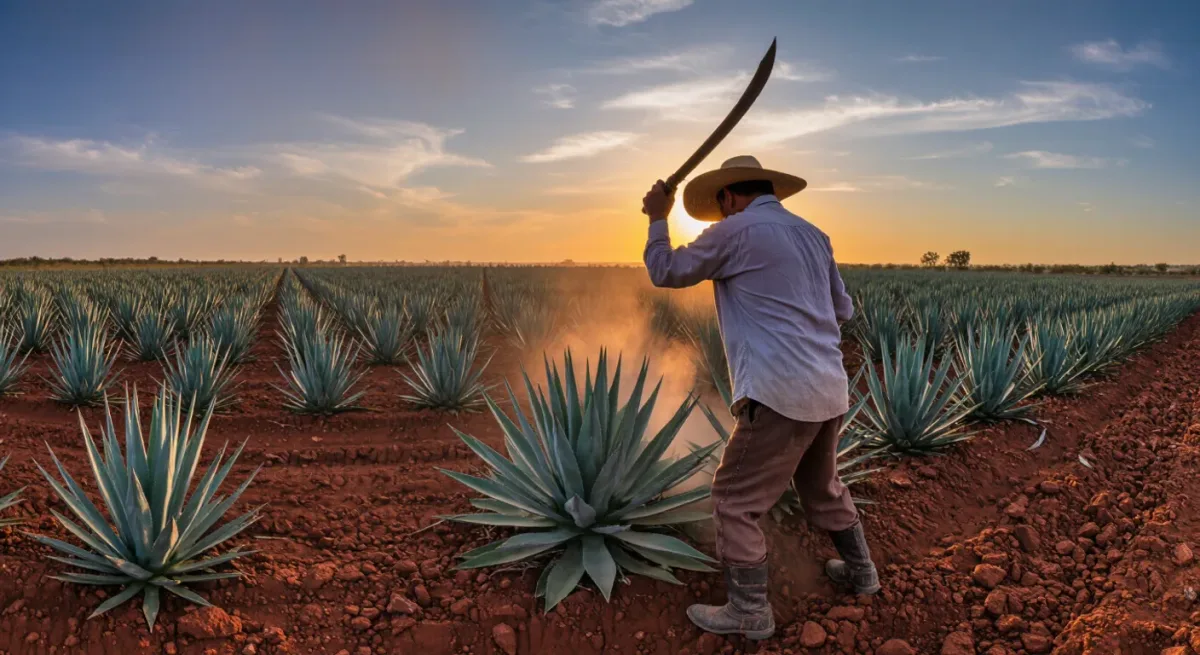
In the highlands of Jalisco, the jimador works with a coa — a flat, round blade on a long handle — trimming blue agave into a bare white piña in minutes, a skill passed through families whose economic calendar runs in seven-year increments. That is the time a blue weber agave needs in the ground before harvest, and it is the single fact that makes tequila unlike almost any other global spirits business: demand can spike in a quarter, but supply answers on a biological schedule. Tequila's export value has more than tripled in roughly a decade to nearly four billion dollars a year (Consejo Regulador del Tequila), and every dollar of it rides on planting decisions made half a decade ago.
What 'tequila' legally means
Tequila is a denomination-of-origin spirit, protected in Mexican law and by international agreements: it must be produced from blue weber agave grown in a delimited territory — all of Jalisco plus defined zones of Nayarit, Michoacán, Guanajuato and Tamaulipas — and meet the standards of the official norm the industry's regulator, the CRT, enforces. The label's core commercial split is between mixtos, made with at least 51 percent agave sugars, and '100% agave' bottles, the premium category whose share of exports has climbed steadily. Mezcal, tequila's cousin, follows its own denomination with different agave species and states — a category now riding the same premiumization wave a few years behind.
The agave cycle, in one paragraph
When tequila demand rises, distillers plant more agave; because the plant matures in five to eight years, the market cannot respond quickly, so prices rise; high prices provoke over-planting; seven years later the oversupply arrives and prices collapse; farmers rip out agave for maize or leave fields unharvested; supply thins, prices spike again. The cycle has run for generations. Agave that traded at cents per kilogram in the mid-2000s glut became a crop worth dozens of pesos per kilogram in the recent boom — a whipsaw that transferred enormous wealth to growers with patience and bankrupted those who planted at the top (CRT and Jalisco state agronomic data).
| Element | Detail |
|---|---|
| Denomination | Blue weber agave, delimited regions of five states |
| Maturation | 5–8 years from planting to harvest |
| Premium split | Mixtos (51%+ agave) vs 100% agave |
| Export value | Nearly $4 billion a year and rising (CRT) |
Who captures the value
The chain runs from ejido and smallholder growers through the vinatas — the distilleries of Tequila town and the Jalisco highlands — to the global brand owners. The premium tier's value concentrates at the brand and retail end, which is why the celebrity-label era (actors and musicians launching 100% agave marques) makes commercial sense: the liquid is Jalisco's, but the margin is marketing. For growers, the boom years brought bargaining power and, increasingly, contracts and vertical integration as distillers secure future supply. For the towns, tequila tourism — the José Cuervo and Herradura estates, the agave landscape itself, UNESCO-listed since 2006 — added a services economy to the industrial one.
The stresses
Three pressures test the model. Disease and climate: agave's boom-to-bust monoculture invites pests and pathogens, and the recent cycle's dense plantings amplified them, while drought raises the plant's already long maturation. Labor: jimadores are scarce because the skill takes years and the work is brutal; mechanizing the harvest has barely begun. And demand concentration: the United States takes the overwhelming majority of exports, tying Jalisco's agricultural cycle to American consumer taste — and to the tariff politics that periodically revisit US-Mexico trade. A spirit that survived a 49 percent US tariff in the 1930s and the agave crash of the 2000s treats such risks as recurring weather.
Why investors keep reading Jalisco's fields
Spirits analysts track agave inventories and planting data the way oil analysts track rig counts, because today's field census is a forecast of 2032's cost of goods. The industry's structural bet is that premiumization outruns the cycle — that consumers who moved from mixto to 100% agave will keep climbing, absorbing higher farm-gate prices as authenticity rather than inflation. So far the bet has paid: each price cycle has settled at a higher floor than the last. The agave fields of Amatitán and Arandas are, in that sense, the slowest-moving futures market in the beverage industry — and among the most reliable.
The mixto wall and the premium climb
The industry's internal frontier is the ratio of mixto to 100% agave in the export bottle. Mixtos — the 51-percent-minimum blends that built tequila's volume era — are a mature, margin-thin category concentrated in big brands and price-sensitive markets; 100% agave is where acreage, craft stories and price growth live, and its share of export volume has risen steadily as the premiumization decade ran. The economic consequence is a quiet repricing of the whole appellation: when the growth is at the top, the value of good highland agave rises relative to the lowland volume crop, distilleries re-tool for small-batch flexibility, and the CRT's registry fills with premium expressions that would have been uneconomic at mixto prices.
The premium tier is also where the denomination's discipline pays. A 100% agave product must be bottled in the denomination region — a rule mixtos escape, which is why bulk mixto ships to bottlers abroad while the premium liquid stays in Jalisco — so the category's growth concentrates employment and margin inside the appellation rather than exporting it. That domestic-capture clause, more than any marketing campaign, is why tequila's boom built distillery tourism, visitor centers and the agave-landscape economy around the town of Tequila itself: the premium product legally cannot leave.
For another Mexican tradition that became a global industry, read our feature on the Day of the Dead economy, and explore the Mexico section.