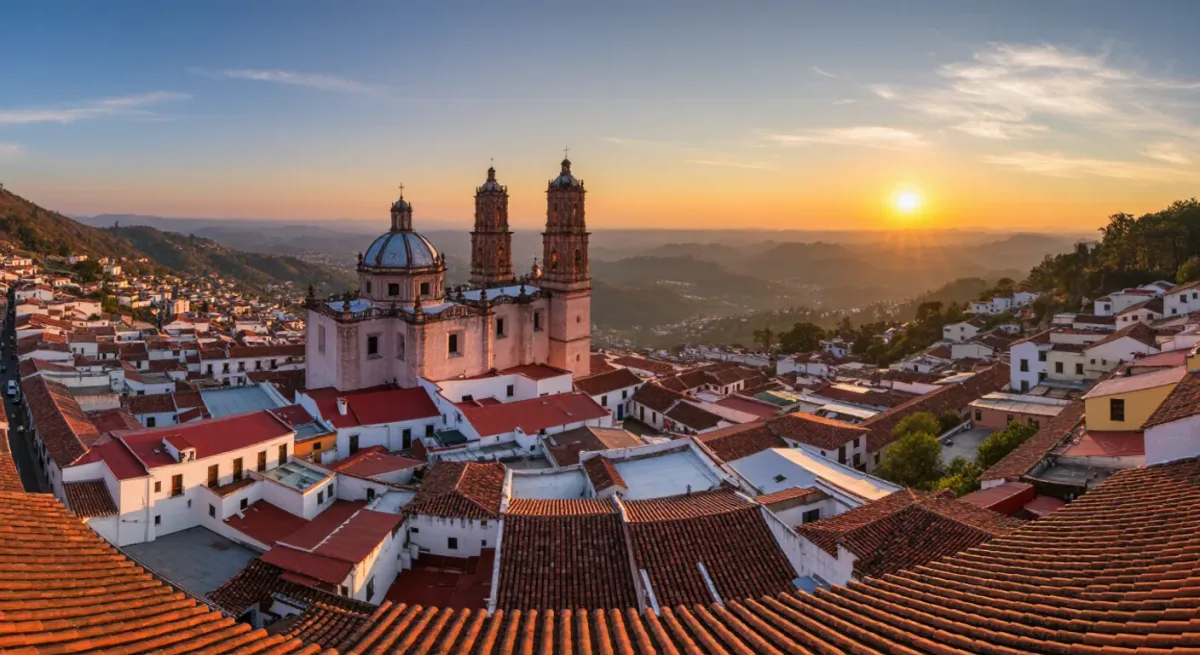
At the Fresnillo mine in Zacatecas — working silver continuously since the 1550s — haul trucks still feed a mill whose metal ends up in Indian jewelry, Chinese solar paste and investment vaults. Mexico has ranked as the world's largest silver producer for well over a decade, extracting on the order of 6,000 tonnes a year, roughly a fifth of global mine supply, and no company embodies that dominance like Fresnillo plc, the Mexican group listed in London that operates the eponymous mine and its siblings across the Zacatecas silver belt (USGS Mineral Commodity Summaries; company reports). One country, one metal, one corporate dynasty — with a silversmithing town for a storefront.
Five centuries of silver
Silver is the metal that made colonial Mexico: Zacatecas and Guanajuato strikes in the 1540s-1560s financed the Spanish empire, minted the pesos that became the world's first global currency, and drew the roads, forts and cathedrals that still structure the region's geography. The industry's modern era industrialized that same endowment — Fresnillo, Saucito, Juanicipio, Peñasquito (a giant polymetallic operation whose by-product silver ranks among the largest sources) — run by companies descended from the industrial groups that consolidated Mexican mining in the twentieth century. The names changed; the ore bodies did not.
How the business actually earns
Mining economics 101: silver comes in two flavors. Primary silver mines — Fresnillo's specialty — are rare and high-cost, and their viability swings with the silver price. The majority of the world's silver arrives as a by-product of lead, zinc, copper and gold mining, which means supply responds weakly to silver's own price: the gold or copper mine keeps digging regardless. That supply inelasticity is the thesis behind silver's violent price moves — and behind the investor attention the metal receives whenever solar panel demand (each panel uses grams of silver in its conductive paste) pushes against stagnant mine supply. Mexican output, like the global industry's, has plateaued: the easy ounces at the great camps are mined, grades decline, and new discoveries take a decade to permit and build (USGS; company reserve statements).
| Fact | Detail |
|---|---|
| Mexico's rank | World's largest producer, 10+ consecutive years |
| Annual output | ~6,000 tonnes of mine silver |
| Flagship operator | Fresnillo plc (London-listed, Mexican-controlled) |
| Historic camps | Zacatecas, Guanajuato, Taxco, Pachuca |
Taxco: the craft economy on top of the hole
Taxco, in Guerrero, mined its last industrial silver decades ago and survives on the metal's mythology: a colonial hill town of silversmith workshops founded on the design school William Spratling established there in the 1930s, which trained the generations whose silver marks still fill the town's shops. Taxco's economy demonstrates the value-capture gap that defines silver in Mexico — the country mines a fifth of the world's supply, yet the fabrication, branding and retail margins concentrate in Italy, the United States and Asia. Spratling's line, and the artisan industry it seeded, is the standing counterexample: a craft cluster that has outlived its own mines by half a century.
The modern pressures
Mining in Mexico now negotiates a harder environment: permitting timelines that stretch projects by years; security costs in the northern and Guerrero belts where extortion targets cargo; a 2023 mining-law reform that tightened concessions and added lithium to the state-reserved list; and community consultations whose outcomes can no longer be assumed. Silver's own price cycles compound the politics — the metal's investment-driven spikes (2020's retail squeeze era, the solar-demand narrative) alternate with long flat stretches that thin the exploration pipeline. The country that owns the metal's history still owns its present; whether it owns the next decade's growth is a permitting and exploration question, not a geological one.
Why follow it
Silver is the quiet commodity in the energy transition — nowhere in the headline critical-minerals lists, everywhere in photovoltaics and electronics — and Mexico is its Saudi Arabia. For anyone mapping where the raw materials of decarbonization actually come from, the Zacatecas belt belongs on the chart beside the lithium salars and copper pits of the Andes. The trucks at Fresnillo are still loading sixteenth-century history into twenty-first-century supply chains.
Who actually buys the metal
Silver's demand map explains its price behavior. Roughly half of global fabrication is industrial — the metal's unbeatable conductivity makes it irreplaceable in solar paste, electronics and brazing alloys — and that share has risen with the energy transition; jewelry and silverware, led by India's enormous consumer market, take most of the rest, with investment bars and coins the swing category that amplifies price moves. The solar link is the strategic one: each photovoltaic panel carries a few grams of silver, and a terawatt-scale build-out converts grid plans into metal demand on a schedule miners cannot match — a structural thesis the market rediscovers every time panel installations beat forecasts.
For Mexican producers, the demand mix is a mixed blessing. Industrial demand grows with decarbonization but buys on contract; investment demand spikes on fear and pays spot. The country's output profile — primary mines like Fresnillo's with high-grade ounces, polymetallic credits at Peñasquito — positions it well in either regime, which is the portfolio logic behind the corporate structure: Fresnillo plc's parent owns the gold side, the listed company runs the silver and the zinc-lead credits hedge both. Geography does the rest. As with copper in the Andes, the world's energy build-out keeps finding its way to Mexican ore bodies — a nineteenth-century mining map that keeps winning the twenty-first century's procurement tenders.
For another Mexican commodity whose global price is set partly by tradition, read our feature on tequila's agave cycle, and explore the Mexico section.