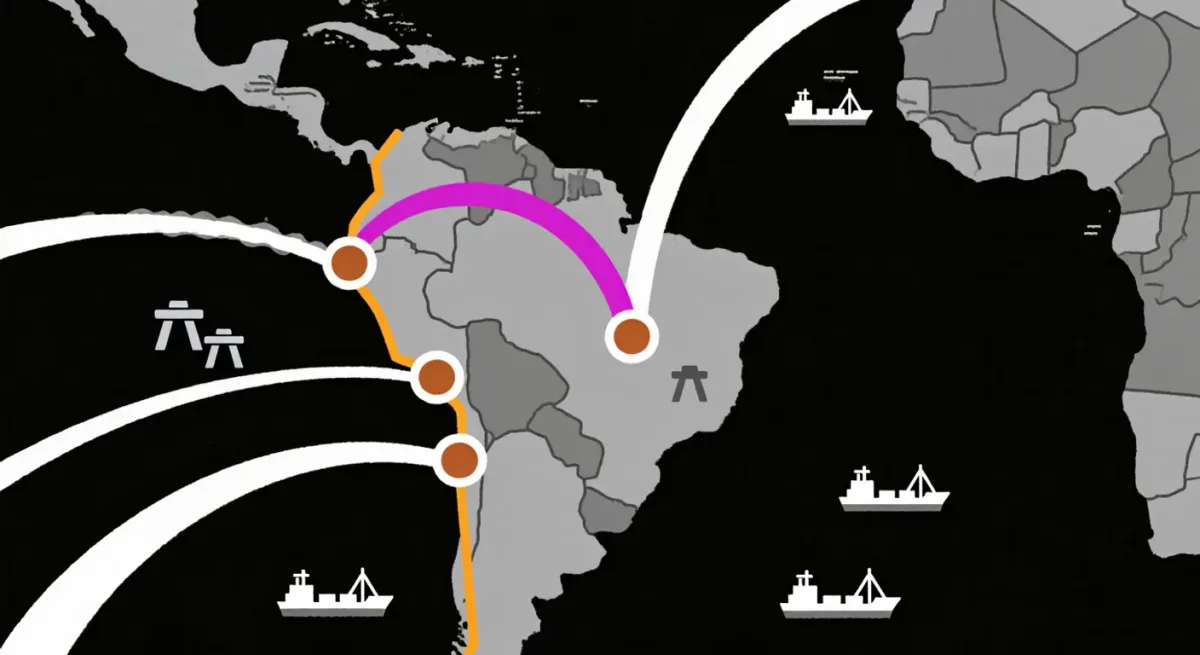
Every electric vehicle, grid upgrade and data center is, at the bottom of its bill of materials, a copper order — and roughly a third of the world's mine supply comes from two Andean neighbors: Chile, the largest producer at around a quarter of global output, and Peru, the second at about a tenth. The price signal has been unmistakable: copper has set repeated record highs above eleven thousand dollars a tonne since 2024, and each record re-prices the Atacama desert's pits and Peru's Andean corridors as strategic assets rather than commodity plays (USGS; International Copper Study Group; LME price records).
Chile: the incumbent's arithmetic
Chile's challenge is mature-basin arithmetic. Codelco, the state miner that alone supplies several percent of world output, has seen production decline as its flagship deposits age and big new projects — the underground conversions at El Teniente and Chuquicamata — ramp slower than the old pits faded. The private majors are the growth story: BHP and partners' Escondida remains the world's largest copper mine; Teck's Quebrada Blanca, Anglo American's Los Bronces and the Collahuasi joint venture carry the medium-term pipeline. Chile's policy response — a royalty reform tied to prices, lithium expansion through Codelco, and a permitting push framed as strategic — aims to hold share in a market where holding share is growth (Cochilco statistics).
Peru: the geology waiting on politics
Peru's reserves rank among the world's largest and its operating base — Cerro Verde, Las Bambas, Antamina — is world-class, but the pipeline is a seminar in social conflict: community road blockades have repeatedly closed Las Bambas; new projects like Tía María have waited more than a decade amid protests; and each election cycle re-opens the question of whether mining is welcome. The result is the region's paradox: the country best positioned to add tonnes in the 2020s has added the least certainty (MINEM production data; documented blockade history).
- Chile output: ~5.3-5.6 million tonnes a year, roughly a quarter of world supply.
- Peru output: ~2.5-2.7 million tonnes a year, roughly a tenth.
- Key operators: Codelco, BHP/Escondida, Teck, Anglo American, Glencore, Freeport, MMG (Las Bambas), Southern Copper.
- Price marker: LME records above $11,000/tonne since 2024.
The demand math behind the records
Copper's bull case is arithmetic, not narrative: electrification uses three to five times more copper per unit of activity than combustion-era infrastructure, and the grid build-out, EV fleets, wind and solar all compound on top of a data-center boom that arrived uninvited. Supply, meanwhile, behaves like a geriatric: grades are declining industry-wide, new mines take a decade-plus to permit and build, and the 2020s' project cancellations set the late-2020s' supply ceiling. Forecasters' consensus of a structural deficit is the price record's engine — with the standard caveat that copper's demand is cyclical too, and a global industrial recession would test every thesis on the board.
| Producer | Approx. annual output | Character |
|---|---|---|
| Chile | ~5.3-5.6 Mt | Mature; underground conversions |
| Peru | ~2.5-2.7 Mt | World-class base; social conflict |
| Combined share | ~1/3 of world | The transition's supply core |
The frictions that decide the decade
Three, ascending in difficulty. Water: Atacama operations pump and desalinate in one of the driest deserts on earth, and every expansion's water balance is now the permitting battle. Taxation: both countries re-priced mining rents during the boom — Chile's 2024 royalty regime, Peru's windfall debates — recalibrating the investor's split without stopping investment. And geopolitics: the 2025 US copper tariffs split the world price into an American premium and a rest-of-world discount, forcing traders to route physical metal through arbitrage choreography and giving producing countries a new variable no geological model contains (US tariff proclamations; LME/COMEX spread record).
The honest outlook
The Andes will supply the copper of the transition because they already supply it and nobody else can scale faster — the DRC and Indonesia add tonnes, but Chile and Peru hold the operating base, the know-how and the ports. The question is the slope: whether Chile's conversions land on schedule, whether Peru unlocks one of its stalled giants, and whether politics lets either country promise the 2030s' mines in the 2020s. The price records say the world wants the answer; the project pipeline says the Andes is deciding it slowly.
The water ledger of the Atacama
The desert that made Chilean mining cheap is now the industry's binding constraint, and the response has been an industrial pivot as large as any mine: desalination. The major coastal operations — Escondida's plant among the earliest and largest — now pump seawater treated and pushed kilometers inland and uphill, at energy costs that reshaped mine electricity demand and motivated the sector's renewable procurement wave. The mining-desal complex has become a strategy in itself: new projects are designed seawater-first, communities negotiate water basins as seriously as royalties, and the state's water-code reforms pushed rights trading and efficiency standards into the sector's core planning. Copper's low-carbon sales pitch now rests partly on this machinery — the metal's green credentials depending on a water system built at real cost, an irony the industry has simply decided to engineer around rather than argue.
Peru's water geography is different — its mines sit in the high Andes' glacier-fed basins, where the conflict is allocation among communities, agriculture and mining rather than absolute scarcity — and the social license arithmetic reflects it: water is the first item on every consultation agenda, and the projects that have succeeded built community water infrastructure before they built processing plants. The two countries' contrast is instructive for the global transition: Chile's constraint is capital and energy, solvable on a balance sheet; Peru's is trust, which no balance sheet directly buys.
For the region's other transition metal and its very different politics, read our explainer on green hydrogen's Latin American bet, and explore the Latin America business section.