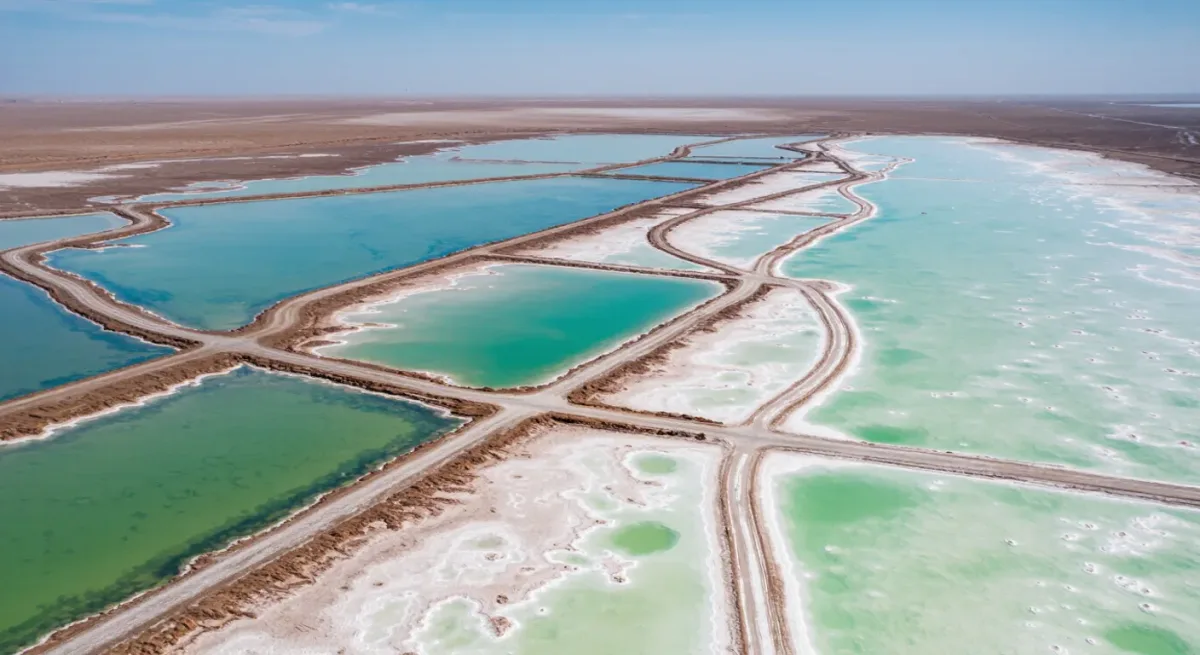
The lithium triangle is the high-altitude salt-flat zone where Argentina, Chile and Bolivia meet, holding the world's largest concentration of lithium-rich brine, and Argentina is its fastest-growing producer, adding new projects even through a brutal price crash. The salt flats sit above 3,000 meters in the puna, where ancient closed basins evaporated and left brines loaded with lithium. Pump the brine, evaporate it in ponds for over a year, process it into carbonate or hydroxide — that is the triangle's basic business model, the cheapest route to battery-grade lithium when nature cooperates (USGS mineral summaries; Secretaría de Minería).
Why each country behaves differently
Same resource, three constitutions. In Argentina, subsoil resources belong to the provinces, so Jujuy, Salta and Catamarca court investors directly and the federal government mostly cheers from the side. Chile classifies lithium as strategic and has run its output through two incumbents, SQM and state copper giant Codelco, under a state-led strategy adopted in 2023. Bolivia declared the resource state property decades ago and has pursued state-led development with serial international partners and modest output to show for it. The result: Argentina, the middle-sized producer, has the queue of projects.
| Country | Resource regime | Market approach |
|---|---|---|
| Argentina | Provincial ownership | Open to private and foreign operators; dozens of active projects |
| Chile | Strategic state resource | Concession-based, dominated by SQM and Codelco |
| Bolivia | State property | State-led with foreign partners; limited output |
Who operates in Argentina's puna?
The map reads like a mining-industry directory. Arcadium Lithium — formed from Livent and Orocobre, and acquired by Rio Tinto in a 6.7-billion-dollar deal completed in 2025 — runs the Salar del Hombre Muerto and Olaroz operations. Ganfeng Lithium and Lithium Americas developed Cauchari-Olaroz in Jujuy. POSCO built an integrated plant in Salta. Chinese, Canadian, Australian and Japanese names hold the rest of the pipeline of roughly forty projects at various stages, from early drilling to construction (Secretaría de Minería project registry).
What happened to prices?
The industry's boom-bust education arrived fast. Lithium carbonate prices rose roughly tenfold to late-2022 peaks near 80,000 dollars a tonne on electric-vehicle euphoria, then collapsed below 10,000 dollars as Chinese and Australian supply flooded the market. The crash stalled expansions worldwide — but Argentina's pipeline kept moving, because brine projects locked in during the boom take years to unwind and because the Milei government's RIGI investment regime dangled tax stability at new large projects. Argentina has consequently closed the gap with Chile as the region's leading brine producer, sitting third in the world behind Australia and Chile (USGS).
What could go wrong?
Four watch items. Price: several Argentine projects clear costs only in the upper single digits of thousands of dollars per tonne, so a long price trough delays the pipeline without killing it. Water: brine extraction draws on aquifers in one of the planet's driest places, and basin hydrology science is genuinely unsettled — community consent in the puna is a hard operational input, not a public-relations line. Technology: direct lithium extraction, which promises higher recovery with a smaller footprint, could reprice the pond model mid-decade. And demand: every forecast assumes electric-vehicle growth that policy, not geology, decides.
Why the world watches
Battery supply chains concentrate risk: Australia dominates spodumene, China dominates refining, and buyers in Detroit, Seoul and Brussels want alternatives. Argentina offers the West's most credible non-Australian growth story — private-sector-led, export-oriented and volume-hungry — which is why every US Treasury delegation, Korean trade mission and automaker procurement chief that passes through Buenos Aires asks about the puna. The salt flats have become a small but hard node in the industrial policy of countries thousands of kilometers away.
The view from Jujuy, Salta and Catamarca
Lithium is the first commodity boom in living memory that Argentina's federal structure delivers to three northern provinces rather than to Buenos Aires-centered industries. Jujuy, Salta and Catamarca — among the country's poorest — collect royalties on every tonne, negotiate community agreements with the basin's Indigenous and criollo communities, and have watched their budgets and ambitions reprice around the salt flats. The Salar del Hombre Muerto in Catamarca has produced since the late 1990s, when the operation that became Livet-derived Arcadium established that Argentine brine could supply a global chemical company; Olaroz in Jujuy followed, and the provincial capitals filled with the exploration geologists, drilling contractors and community-relations officers the industry requires.
The provincial politics are not decorative. Community consent is a legal and operational precondition — roads cross communal land, water tables sit under shared pastures, and a blockade at a salt flat can idle a project as effectively as a court order — so companies employ liaison staff, fund local works and negotiate employment quotas in a style mining lawyers describe as closer to treaty-making than permitting. Provincial governments, for their part, juggle the investor's demand for stability against constituencies that want refineries, not just wells: every announcement of a cathode or battery-component plant, at any technology readiness level, is political currency. The honest gap is employment — brine operations are chemically intensive but not labor-hungry — which is why the provincial dream concentrates on downstream conversion, and why skeptics note that every lithium province on earth shares it.
Argentina's lithium history is older than the current boom: commercial brine production at the Salar del Hombre Muerto began in the late 1990s, the proof of concept that Argentine salt flats could feed a global chemical company. The royalties, community funds and provincial agencies built since then are why later projects arrived faster — the institutional pavement was already laid.
For the other resource reshaping Argentina's trade balance, see our explainer on the Vaca Muerta shale formation, and browse the Argentina section for more.