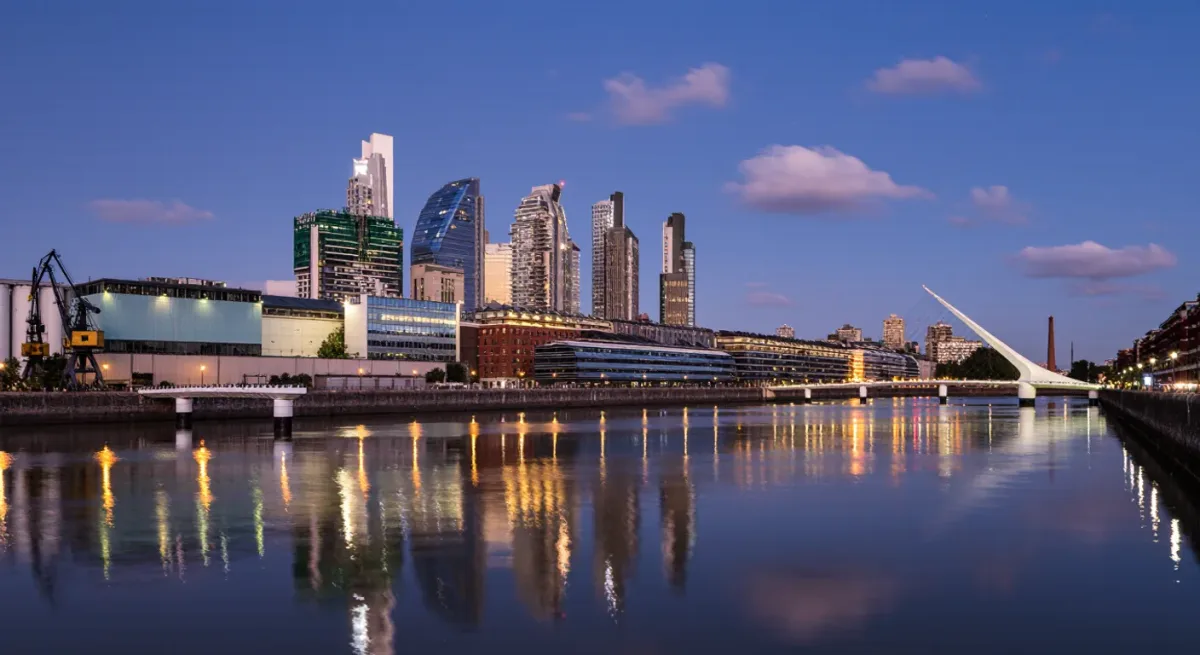
In 1999, Marcos Galperin was finishing his MBA at Stanford when he launched an online auction site for his home market — a country where fewer than one in a hundred people had internet access. That company, Mercado Libre, is today Latin America's largest e-commerce and fintech group, one of the region's most valuable listed companies with a market capitalization that has crossed 100 billion dollars, and the reference point every Argentine founder now pitches against. Its headquarters function — engineering, product, design — still draws heavily on Buenos Aires talent. The city that produced it has become one of the developing world's more improbable software-export hubs (company filings; CESSI industry data).
Why instability breeds engineers
Argentina's tech export strength has a perverse origin. Decades of currency volatility, capital controls and crises taught three habits that map neatly onto software entrepreneurship: talent is the only portable asset, dollar revenue is the only trustworthy revenue, and every process should be automated before the next shock arrives. The state contributed the other half: public universities, above all the University of Buenos Aires, graduate mathematicians, physicists and engineers at world scale and near-zero private cost, feeding a labor pool priced in pesos and billing in dollars. Software and IT services exports have run above two billion dollars a year in recent totals — small next to agriculture, but growing in the opposite direction (CESSI).
The house that three companies built
Three corporate stories established the ecosystem's proof points:
- Mercado Libre (1999): proved an Argentine team can build and hold a region-scale consumer platform; its fintech arm Mercado Pago, created to solve payments for its own marketplace, became a bank for tens of millions of unbanked users across the region.
- Globant (2003): Martín Migoya and partners built a digital-services firm staffed from Latin America's best engineering schools; it listed on the New York Stock Exchange in 2014 and now employs tens of thousands across the world, with Buenos Aires its creative center.
- Auth0 (2013): founded by Argentines, built identity infrastructure used by enterprises globally, and sold to Okta in 2021 for 6.5 billion dollars — the ecosystem's demonstration that local founders can build infrastructure software, not just regional clones.
How the pipeline works now
The successor generation spreads across fintech (Ualá, Lemon), logistics-tech, agtech and AI services, backed by local funds and international venture capital that treats Buenos Aires as a bargain market for senior engineering talent. The RIGI regime and the broader liberalization of the 2024-2025 macro program added a new pitch: repatriating profits is now a planning question rather than a structural doubt. Remote work did the rest — a global salary ceiling arrived for Argentine developers without anyone emigrating, and the diaspora that did leave now functions as a distribution network for the companies that stayed.
The structural risks
None of this is friction-free. Talent inflation in dollars has compressed the arbitrage that funded the first wave. The domestic market remains too small and too cyclical to anchor demand, keeping the model export-dependent. Brain drain competes with remote work for the same graduates. And the policy environment has historically turned on elections — every founder over 40 carries a memory of a sudden tax, a sudden control, a sudden devaluation that repriced their runway. The sector's bet is that this decade's stability is durable; its contingency plans, without exception, are incorporation abroad.
What to watch
Three indicators tell the story better than any pitch deck: the annual export total (a proxy for dollar demand for Argentine engineering), the flow of global venture rounds into local startups (a proxy for confidence), and the number of RIGI applications from technology and data-center projects (a proxy for long-cycle commitment). All three have moved in the right direction through the mid-2020s — which is, by Argentine standards, the most bullish sentence this publication can responsibly print.
The talent arithmetic, concretely
The ecosystem's core trade has always been the spread between what Argentine engineers cost and what they produce. A senior developer in Buenos Aires bills a fraction of a Bay Area or London counterpart — the gap narrows every year as remote work globalizes pay, but a persistent differential remains, and it is the reason multinationals keep regional engineering hubs in the city and why Globant's model scaled: sell OECD-grade output at South American cost, delivered in overlapping time zones with New York. The 2020-2021 remote-work shock was the sector's singularity — for the first time, thousands of Argentine engineers held dollar salaries without emigrating, and the local labor market repriced around that benchmark. Local companies responded with equity, with dollar-indexed compensation bands, and, when they could not, by training replacements — which is why the industry's education layer, from bootcamps to university extension programs, grew alongside it.
The second quiet asset is failure experience. Argentina's macro history produced generations of founders who rebuilt companies through devaluations, capital controls and reopening cycles — a resilience portfolio managers describe, only half-jokingly, as stress-testing no business school can simulate. The diaspora compounds it: Argentines in senior roles at global technology companies function as an acquisition channel, a referral network and an angel-investor class for the companies that stayed, so that the ecosystem's brain drain and its business development are, functionally, the same people.
For the older cultural export that still sells out theaters worldwide, read our feature on Buenos Aires' tango economy, and explore the Argentina section for more.