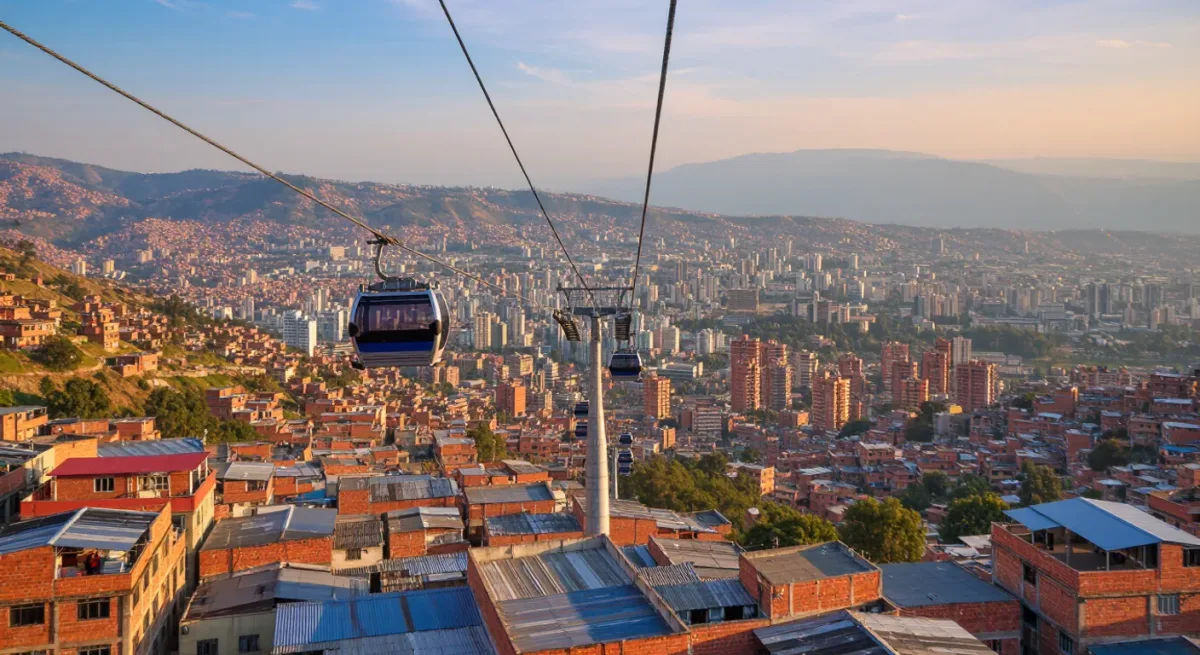
In 1991, Medellín registered a homicide rate around 380 per 100,000 residents, among the highest ever recorded for a city in peacetime — the arithmetic of the cartel wars. Three decades later the figure has fallen by more than ninety percent, the metro and its cable cars move a million riders a day through valleys that once had no formal access, and the city's annual business school case-study traffic may be its second-largest export after textiles. Very few cities have re-engineered both their statistics and their narrative this completely; how Medellín did it, and where the model strains, is worth exact attention (Medellín city statistics; National Police data as publicly reported).
The sequence, not the miracle
The transformation is usually compressed into the word 'innovation'; the record is more procedural. First came security and state presence, re-taking neighborhoods institution by institution. Then came what urbanists now call social urbanism, concentrated roughly between 2004 and 2011 under mayor Sergio Fajardo: the library parks — five architecturally ambitious civic complexes in the poorest districts — the Metrocable aerial lines connecting hillside barrios to the metro, escalators in Comuna 13 replacing 500-odd stair steps, and schools built to cathedral budgets. The theory was explicit: put the best public infrastructure where private investment never went, and dignity becomes infrastructure.
- Metro (1995): Colombia's only metro system, the spine every later project plugs into.
- Metrocable lines (2004 onward): aerial gondolas integrated into the metro fare, cutting hillside commute times from hours to minutes.
- Library parks (2004-2008): Parque Biblioteca España and its siblings, programming-heavy civic anchors on the hillsides.
- Innovation district (2010s): the Ruta N corridor, pairing municipal labs with university and corporate R&D.
What actually moved the numbers
Economists dispute the weighting, not the ordering. Security policy changed the baseline; the Pentagon and police strategy of the 1990s-2000s dismantled the cartel structures, and demobilization politics removed armed actors' monopolies on territory. The urbanism layered onto that peace — transit time, school access, visible state quality — made the security gains durable by changing what the territory was for. Foreign direct investment in Medellín, sector clustering around energy, textiles and business services, and a convention-and-tourism economy that simply did not exist in 1995 followed the statistics down and the rankings up: the city earned honors from international urban institutions and, in 2013, the Urban Land Institute's recognition as the world's most innovative city, an award worth more in perception than in dollars — and worth a lot in dollars.
| Indicator | Early 1990s | Recent period |
|---|---|---|
| Homicides per 100,000 | ~380 (1991) | Fallen by more than 90% |
| Hill barrio transit | Informal, hours-long | Metrocable + metro integration |
| Identity | Cartel war capital | Innovation district, Ruta N, tourism boom |
Where the model strains
Honesty about Medellín requires the second half of the ledger. Inequality in the city remains among Colombia's worst despite the showcase districts; new armed groups compete for micro-trafficking territory in the same barrios the cable cars serve, and homicide numbers have oscillated in recent years rather than continuing to fall; displacement from rural conflict still arrives at the city's edges faster than housing policy absorbs it. The informal settlements keep growing uphill. Urbanists who studied the showcase years now write about the hard phase: maintaining infrastructure quality is less photogenic than inaugurating it, and the 'Medellín model' has proven easier to export as a lecture than to complete at home.
What other cities actually copy
The exportable part is narrow and real: integrate informal settlements into the formal city through transit rather than pretending they will disappear; spend architectural ambition on the poorest's public space, because that is where state absence did the damage; and treat a metro system as the fixed asset around which everything else sequences. Rio built cable cars on the model; cities from Mexico City to Manila study the library parks. The full package — security politics, mayoral continuity, a public-utilities company (Empresas Públicas de Medellín) whose profits financed much of the urbanism — is harder to franchise, which is precisely why Medellín is a case study rather than a template.
What the mobility research found
The Medellín model's most cited academic finding concerns time. Studies of the Metrocable lines published after their opening found significant reductions in commute times to the city center for hillside residents — from improvised, multi-leg journeys measured in hours to integrated rides measured in minutes — with measurable knock-ons in employment access, school attendance and healthcare utilization. The finding sounds modest; its policy implication is not. Transport, the research suggested, was functioning as the binding constraint on formal economic participation for precisely the population the showcase projects targeted, and aerial transit — cheap per kilometer served compared to tunneling, adaptable to slopes no bus could climb — turned out to be the rare infrastructure class whose unit economics favored the poor periphery over the served center.
The library parks produced their own literature. Usage studies found the complexes functioning as designed: attendance drawn from their immediate hillside catchments, programming schedules that made them community living rooms rather than monuments, and measurable educational and civic-use indicators. Urbanists generalized the lesson into a proposition now cited on every continent — that visible public quality in neglected neighborhoods changes both external perception and internal norms — while careful evaluators add the caveat that infrastructure of any quality arrives embedded in a wider program of security and services. Medellín's transferable insight is sequencing: the cable cars and libraries worked because they arrived with the state that built them.
For another city-brand turnaround in the region, read our guide to Peru's tourism machinery around Machu Picchu, and explore the Andes section.