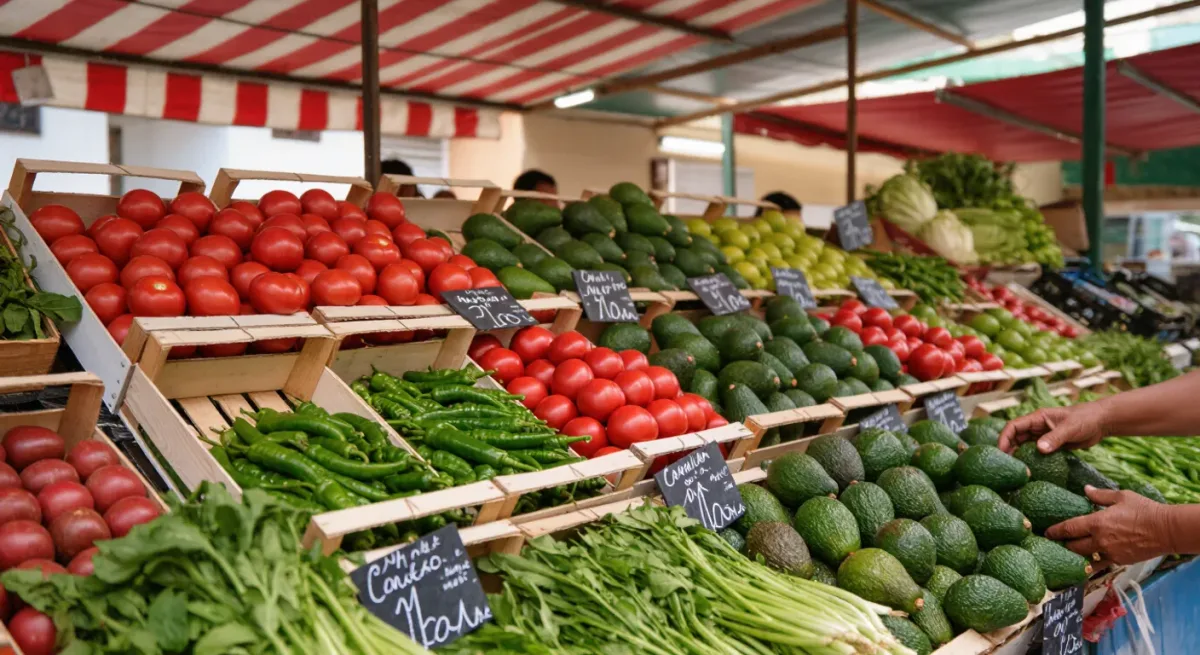
Annual headline inflation in Mexico rose to 3.8 percent in January, up from 3.69 percent in December, INEGI's consumer price index showed — an uptick that keeps the index inside the central bank's tolerance band but above its 3 percent target, and that lands days after Banxico's decision to pause its rate-cutting cycle at 7.00 percent. Food prices rose faster than the general index, continuing the pattern that has defined Mexican inflation's stubborn layer (INEGI CPI release; Mexico Business News reporting on the data).
What moved in the basket
January is a seasonally loud month in Mexico: regulated price adjustments, the start-of-year service repricing and the minimum-wage increase all pass through the index at once, and analysts read the month with seasonal filters. The component story, though, is consistent across recent prints: agricultural and processed food prices have run ahead of the headline, energy effects have been contained by government subsidies on gasoline, and core inflation — the series that predicts the future — has declined more slowly than headline, with services inflation the stickiest residue of the past three years. The index's return toward the target's neighborhood has been real but uneven, and January documented the unevenness.
Why the timing matters
The print is the first hard data point of the year for a central bank that chose patience on February 5. A rising headline does not by itself threaten the tolerance band — 3.8 percent sits comfortably inside the 4 percent ceiling — but the composition does the worrying: if food and services momentum carries into February and March, the case for resuming cuts weakens, and the market's mid-year resumption pricing reprices. Conversely, if the January bump proves seasonal, Banxico's pause looks conservative and the easing path reopens for the second half. The February reading, published in March, becomes the tiebreaker (analyst coverage of the release).
| Measure | December 2025 | January 2026 |
|---|---|---|
| Headline, annual | 3.69% | 3.8% |
| Banxico target | 3% ± 1 pp | |
| Food vs headline | Food outpacing the general index | |
Household economics
For households, the food detail is the inflation that counts. Lower-income families spend a far larger share of income on food, so a food-led index premium is a regressive tax measured in percentage points; the January data showing food above headline is thus a distributional fact as much as a monetary one. The counterweights — minimum-wage increases that have outrun inflation for several years, and remittances near record levels — have kept real incomes growing on aggregate even as specific baskets tighten. The political economy of 2026 Mexican inflation is this balance: nominal wages rising, food sticky, and a government acutely aware that both appear on kitchen tables before they appear in polls.
The regional context
Mexico's January print sits mid-table for the moment's Latin America: well below Brazil's situation, where the central bank has been forced to hold rates at cycle highs into an inflation scare, and roughly in line with the region's commodity-exporting disinflation mainstream. The difference is the target's proximity — Mexico is arguing about tenths above 3 percent while peers argue about points above 4 — a position won by Banxico's early hiking and defended, this month, by a pause.
What to watch
February's CPI in early March; the core services series inside it; Banxico's late-March decision and the quarterly inflation report that accompanies it; and the peso's behavior through the USMCA review headlines, since the pass-through from exchange rate to prices is the channel that could still reopen the whole debate. The disinflation war in Mexico is over; the food-and-services skirmish continues.
How the index is built — and why the details rule
INEGI publishes Mexico's CPI on two clocks: biweekly readings — the quincenales that give the central bank its earliest signals — and the full monthly index that anchors the annual comparison. Inside the headline sit two series that professionals read asymmetrically. Core inflation — merchandise and services, stripped of the volatile food and energy items — is the predictive series, because it measures the inflation that expectations and wages are actually set against; non-core carries the noise of harvests, administered price adjustments and global energy. January's reading was a textbook case of why the split matters: the headline uptick was concentrated in the seasonal and regulated components, while the services core — the wage-indexed residue of the past three years — continued its slow decline without yet convincing anyone it has converged.
The services component deserves its own sentence: rents, education, personal services and restaurant prices are where inflation either dies or lodges, because they respond to domestic wage cycles rather than exchange rates or commodity shocks. Mexico's minimum-wage policy — successive years of increases well above headline inflation, a deliberate redistribution with a monetary footprint — feeds directly into this component, and Banxico's communications have flagged exactly this channel as the reason the last mile toward 3 percent is slower than the first mile from 8. The January data preserved both halves of that story: progress that is real, and a floor that has not yet released.
The regional frame: Brazil's February print, released the same month, fell to 3.81 percent from above 4 — both countries converging toward their targets from different directions, and both central banks now governing the last mile rather than the crisis.
For the monetary decision that preceded this print, read our report on Banxico's February hold at 7.00 percent, and follow the wider file in the Mexico section.