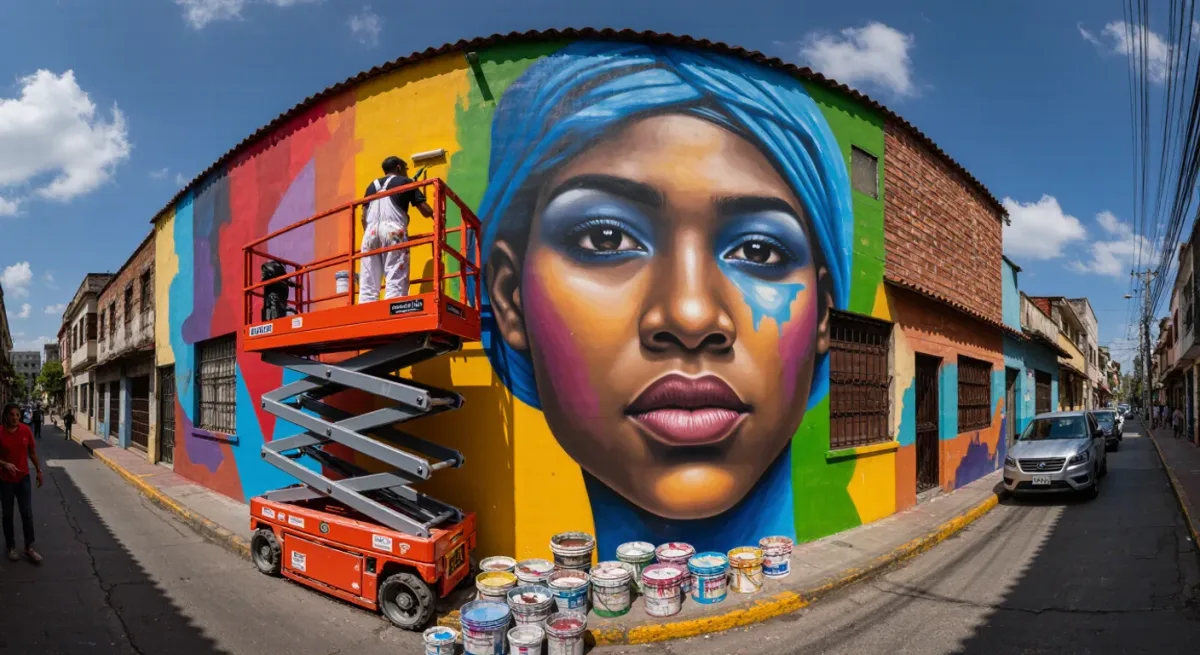
In the 1920s, Mexico's new revolutionary government handed its best painters the walls of its buildings — and Diego Rivera, José Clemente Orozco and David Alfaro Siqueiros filled them with the nation's entire argument: conquest, industry, indigenous Mexico, class war. Muralism was the first modern art movement conceived as public infrastructure, paid by the state, immune to private collection by design. A century later the market has had its revenge and its tribute: the record price for a Latin American artwork at auction — Frida Kahlo's 'Diego y yo,' sold at Sotheby's in November 2021 for 34.9 million dollars — was set by a canvas from the same milieu, and every city in the hemisphere now commissions murals as economic policy (auction records; public art program records).
Why the murals cannot be sold — and why that made them priceless
The murals' site-specificity created a peculiar asset class: value that cannot change hands appreciates culturally instead. Rivera's staircase at the National Palace, Orozco's Hospicio Cabañas in Guadalajara, Siqueiros' Polyforum — these are now anchor monuments of national identity and tourist itineraries, generating entrance, travel and city-brand income no private canvas could. UNESCO's World Heritage list took the whole package (the murals inside world-heritage buildings); Mexico's tourism economy counts them among its flagship attractions. The lesson was not lost on the region's cities: walls, it turns out, are export infrastructure (UNESCO listings; tourism records).
- The originals: Rivera, Orozco, Siqueiros — state-commissioned, permanently public.
- The market wing: easel works and works on paper from the same artists, sold at Sotheby's and Christie's dedicated Latin American sales.
- The auction record: Frida Kahlo's 'Diego y yo' — $34.9 million in 2021.
- The descendants: Bogotá, CDMX, Valparaíso, Buenos Aires as street-art destinations built on the muralist precedent.
The contemporary street-art economy
The muralist idea — art as urban furniture owned by everyone — returned in the 2010s as municipal strategy. Bogotá, with permissive walls and a decriminalized scene, built one of the world's densest street-art districts; Mexico City, Buenos Aires and Valparaíso market their facades on walking tours; and a professional economy of festival-commissioned murals now pays artists from city budgets, brand sponsorships and tourism boards — the same funding triangle, minus the revolution. The economics are measurable at street level: a commissioned mural re-prices the block it decorates, and cities commission them precisely for that effect — the gentrification critique is part of the genre's own subject matter, painted into the murals themselves.
The collecting market's Latin bracket
Auction houses run dedicated Latin American sales twice a year in New York, and the bracket tells a market story: the modern canon (Rivera, Kahlo, Tamayo, Botero, Matta, Lam) sets the records, contemporary Latin artists cross into the general sales, and the dedicated bracket persists partly because the canon's supply is finite and provenance-heavy — much of it still coming from Latin American collections decades after creation. The 2021 Kahlo record nearly tripled the previous ceiling, and the market read it as the region's price discovery moment: the best Latin modern works re-rating toward global peers rather than regional discounts (Sotheby's/Christie's sale records).
| Era | Economic model |
|---|---|
| 1920s-50s muralism | State commission, public permanence |
| Auction canon | Dedicated sales; Kahlo record $34.9M (2021) |
| Street-art era | City budgets, brands, tourism commissions |
Why it matters beyond art desks
Muralism was Latin America's first demonstration that cultural production could be national policy — the template every later export (literature, film, food) adapted. Its market afterlife demonstrates the second lesson: making art unownable made it permanent, and permanence eventually monetizes at the city scale even when the canvas never leaves the wall. The hemisphere's walls are still being painted on that theory, one municipal budget line at a time.
The festival circuit that pays for walls
The contemporary mural economy runs on festivals: city governments, tourism boards and brand sponsors commission large-scale works through organized events that bring international artists, scaffolding and permits to neighborhoods selected for the purpose. The model converts walls into municipal marketing within weeks — each festival delivering a crop of Instagrammable facades whose content-marketing value the sponsors can measure — and it has professionalized a trade that was once arrest-driven: festival muralists command day rates, travel budgets and crews, and the circuit's top names book years ahead across continents. Latin American cities embraced the format with special enthusiasm precisely because the region already owned the art form's history; commissioning a mural in Mexico City or Bogotá comes with a century of local meaning no northern city can purchase.
The circuit's economics have their own debate, painted into the walls themselves. Artists and critics split over the advertising mural — the building-size brand campaign that pays festival rates — and over gentrification's paintbrush: the mural that raises a block's rents is, functionally, a redevelopment instrument whose first evictions are cheaper than its paint. The genre's honest practitioners negotiate the terms into the work — community consultation, local crews, imagery that documents rather than decorates — in a running argument that has become part of Latin American street art's signature content. The wall, once again, is doing double duty: a canvas and a policy debate, in the same square meters.
The mural economy's annual ledger, in the end, runs through real estate: every commission is a bet that the wall will outearn the paint, and the region's cities keep placing it.
For another canon Latin America cannot export enough of, read our feature on the region's literature business, and explore the culture and entertainment section.